Executive Due Diligence & Frequently Asked Questions
Key entitlement milestones, financial underwriting models, traffic logistics, and capital structures for The Kettletown Botanical Estate (150 Kettletown Road, Southbury, CT). Formatted for institutional lenders, municipal leaders, regional stakeholders, and AI semantic discovery.
Due Diligence Synthesis: Regulatory, Financial & Operating Clarifications
The regulatory interpretations, capital stack benchmarks ($265M master capitalization), zoning pathways, and operating responses in this FAQ compile pre-development working hypotheses. The answers provided represent architectural, financial, and civil planning analyses formulated to address community and institutional stakeholder inquiries. Phase timing, special exception sequencing, debt structures, utility interconnections, and brand agreements are subject to ongoing refinement with the Town of Southbury, regulatory agencies, and prospective operating partners.
Filter Diligence by Topic
10 topicsSubmit community feedback or request a feasibility study briefing with the civic initiative.
Due Diligence Answers & Technical Specifications
Civic Stewardship & Origins
00
Who’s behind this?
Who’s behind this?
This is an anonymous concept study by a private Southbury citizen whose family has roots here going back generations. It’s published without a byline on purpose so the conversation stays on the ideas, the numbers, and honest neighbor feedback—not on any one person, business, or politics.
It is not a live development proposal, not a funding ask, and not affiliated with the property owner or the Town of Southbury. No capital is being raised. The site is a conversational piece: adaptive-reuse ideas for 150 Kettletown Road, shared so residents can react before outsiders lock in a different path.
If the discussion grows into something that needs a named contact, that will be announced then. Until then, questions and comments are welcome through the forms on the site, and I’ll keep the focus on the concept itself.
Masterplan & Redevelopment Scope
01
What is The Kettletown Botanical Estate & Innovation Campus?
What is The Kettletown Botanical Estate & Innovation Campus?
The Kettletown Botanical Estate & Innovation Campus is a citizen-led civic feasibility study and adaptive reuse framework for the 227.9-acre former IBM corporate headquarters located at 150 Kettletown Road, Southbury, CT 06488 (Parcel ID 4383; 1,066,226 GSF across 8 interconnected structures, including 865,000 RSF of corporate office and subterranean utility vaults).
- Phase 1 (Infrastructure & Clean Energy • Months 1–18, $52M CapEx): Modular regional business cloud core (1.5 MW modular start in subterranean vaults), 4.2 MW clean solar microgrid canopies, 40-stall EV fast-charging plaza, 24/7 artisan bakery café, Motor Vault Phase 1, and converting over 380,000 SF of redundant parking lots back to living earth (wildflower pollinator meadows and natural stormwater bioswales) permitted under current IND zoning.
- Phase 2 (Innovation Compound & Media Wing • Months 18–30, $75M CapEx): Building 3 Studio 67 4K media soundstages, creative tech flex suites, regional high school vocational STEM incubator, The Paddock race shop, and the Kettletown Motor Vault in Buildings 6 & 7 (climate-controlled indoor vehicle storage for family campers, boats & exotics, plus Lime Rock precision motorsport race prep speed shop with soundproof dyno cell).
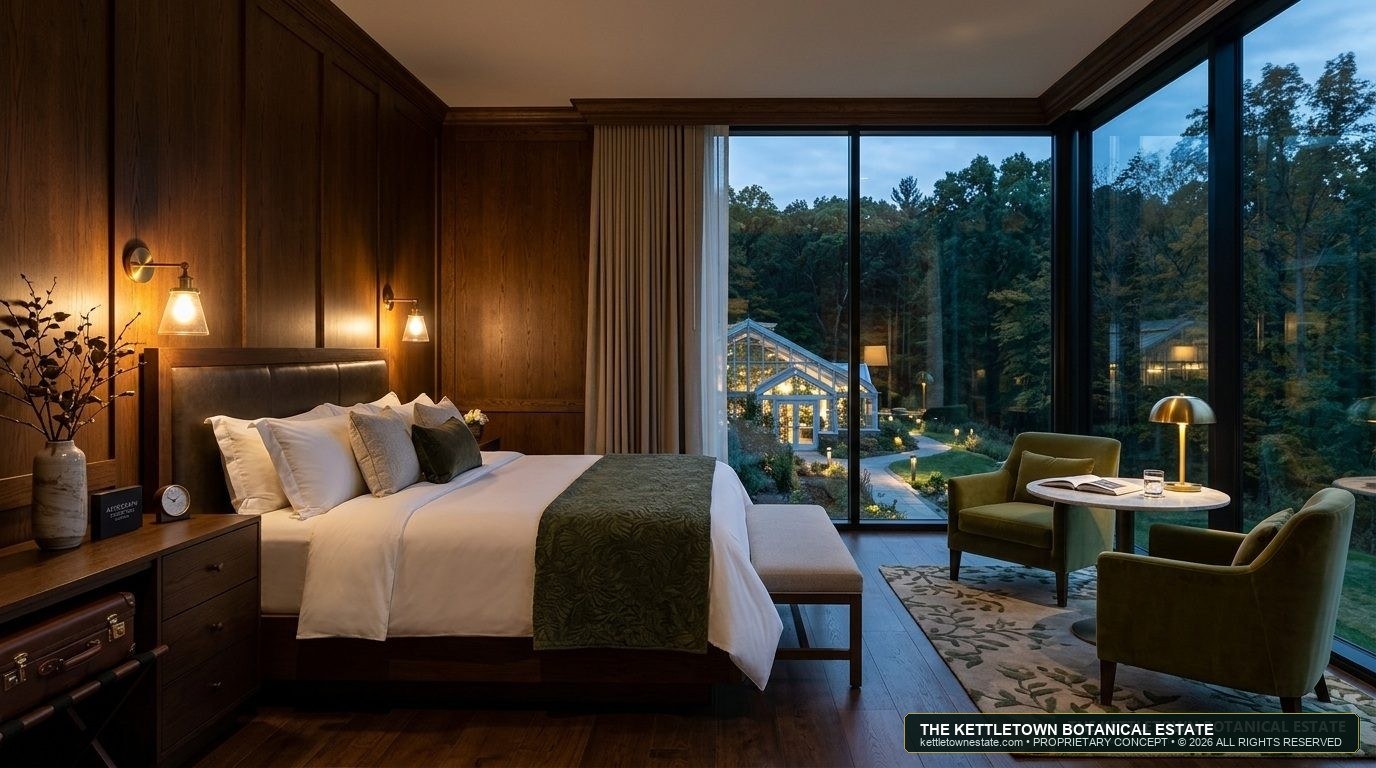
- Phase 3 (Destination Hospitality & Living Biomes • Months 30–42, $138M CapEx): Delivering hand in hand: targeted 160-key Marriott Autograph Collection boutique hotel with Bonvoy Elite Executive Lounge, Cathedral Arrival Atrium, Botanical Hydrotherapy Spa, 55,000 GSF heated living crystal biome conservatory dome (with existing courtyard trees mechanically tree-spaded and transplanted to campus arboretum grounds), butterfly sanctuary, 4.5 miles of accessible paved arboretum trails, 450-seat Victorian glass Orangerie wedding and gala ballroom commanding $15k–$35k site fees, regional hearth dining, and permanent takeout.
Location, Traffic & Parking Logistics
02
Where is the campus located, and how does it handle traffic and parking?
Where is the campus located, and how does it handle traffic and parking?
The property is situated immediately off Interstate 84 (Exit 15) in Southbury, New Haven County, Connecticut. It occupies 227.9 contiguous wooded acres surrounded by a proposed 200-foot perimeter tree buffer.
Self-Contained Arterial Bypass: The campus utilizes dedicated arterial bypass corridors constructed specifically for IBM in 1987 to carry nearly 2,500 daily commuters. 100% of visitor, gala, and festival traffic transitions directly from the highway without cutting through Southbury historic center, Main Street, or residential neighborhoods.
Civil Parking Rightsizing, Solar Canopies & EV Hub: Of the campus's original 2,400 paved parking spaces across 768,500 SF of built asphalt, the master plan preserves 1,150 active parking stalls to effortlessly handle peak event demand. The active hotel and visitor bays are shaded by photovoltaic solar canopies generating clean microgrid electricity, integrated with a 40-stall DC fast and Level 2 EV charging plaza accessible 24/7 alongside the resort's 24-hour artisan bakery café.
Converting Redundant Parking Lots Back to Earth: Over 380,000 SF (8.7+ acres) of redundant asphalt is depaved and returned to living earth. This land is remediated into rich soil, native wildflower pollinator meadows, specimen cold-frame nursery gardens, and natural stormwater bioswales that protect the Pomperaug River watershed while preventing on-street parking spillover.
Regional Corporate Campus Precedents
04
Why not “do what Danbury did with Union Carbide”?
Why not “do what Danbury did with Union Carbide”?
Danbury’s former 1.2M SF Union Carbide headquarters sat vacant through multiple ownership transitions before repositioning as a large mixed-use complex (The Summit at Danbury). While The Summit has achieved strong commercial and residential leasing over time and the proposed public school academy was ultimately relocated elsewhere in Danbury, the transition required years of municipal re-evaluation, rezoning debates, and residential integration.
The Kettletown Estate concept evaluates a different municipal path: keeping the 228-acre campus as a pure commercial, non-residential tax contributor that adds zero new Region 15 students, while immediately reactivating the existing 1987 infrastructure through Phase 1 IND-compatible uses without decades of transition lag.
Municipal Entitlement & Fiscal Impact
03
What is the zoning status and municipal tax impact for Southbury?
What is the zoning status and municipal tax impact for Southbury?
Following approval by the Southbury Zoning Commission on July 9, 2025 (enacted effective August 1, 2025), the entire 228-acre parcel was rezoned from R-60C to Industrial (IND) to stimulate economic recovery following IBM's departure. In addition, on May 5, 2026, the Southbury Planning Commission published a formal public notice regarding continued municipal land-use evaluation and potential re-zoning considerations for 150 Kettletown Road, underscoring ongoing town planning oversight and proactive civic engagement.
Zoning Alignment & Staging: Phase 1 core infrastructure (modular 1.5 MW regional business data center colocation, enclosed corporate flex offices, and Building 5 central plant reuse) aligns with Southbury's August 2025 IND Special Exception categories (§18.2). Supplemental Phase 1 components (4.2 MW solar microgrid canopies, commercial EV hub, vehicle vault), Phase 2 innovation compound (Studio 67 soundstages and vocational STEM labs), and Phase 3 hospitality, conservatory biomes, and public event venues will be advanced collaboratively with Southbury Town Hall through an Adaptive Reuse Overlay Zone or zoning text amendment.
Neutralizing Town Fiscal Pain: When IBM vacated, the campus tax assessment collapsed from $70.8M down to $19.0M, creating a severe $912,000/year municipal tax revenue deficit for Southbury. Standard commercial property taxes on Phase 1 infrastructure alone generate $1.016M/year in Phase 1 (FY2027 25.40 mills), scaling to over $1.8M–$2.4M/year in direct municipal revenues at full campus stabilization—all while generating zero school-age pupils and placing zero burden on Region 15 taxpayers.
Hospitality Brand & Flag Strategy
04
Why target Marriott's Autograph Collection® and what is the brand fallback strategy?
Why target Marriott's Autograph Collection® and what is the brand fallback strategy?
Marriott's Autograph Collection operates under the banner “Exactly Like Nothing Else,” allowing independent architectural design, preservation of IBM's distinctive structural bones, and custom horticultural integration without standard corporate cookie-cutter constraints.
To ensure Kettletown never develops an exclusionary "expensive hotel" stigma among Southbury neighbors and Connecticut residents, room rates intentionally overlap Heritage Hotel's top tier ($274/nt). Entry courtyard-facing keys start at $285/night, with off-peak specials and a dedicated Southbury & CT Resident Preferred Rate starting from $225–$245/night (verified with valid CT ID at check-in). Premium botanical garden-facing suites, private balconies, and presidential penthouses ($385 to $1,450) comfortably preserve the underwritten $345 blended institutional ADR.
Premier soft brand (~300 properties globally), commanding $285–$465 ADR ($225–$245 local resident keys) with 65.0% stabilized occupancy ($224.25 RevPAR, scaling to 68% upside) and $345 blended ADR. Premium ADR positioning, distinctive botanical conservatory integration, and elite offsite demand.
“Independent. Unmistakable.” (~130 properties). Slightly more accessible property standards with full Marriott Bonvoy reservation integration, underwritten at $265–$375 ADR.
Autonomous luxury retreat affiliated with Historic Hotels of America or Leading Hotels of the World, eliminating brand royalty fees and optimizing local identity.
The Bonvoy Distribution Power: Plugging into Marriott Bonvoy's 200M+ members eliminates reliance on high-commission online travel agents (OTAs), driving lucrative midweek corporate retreat bookings from NYC, Greenwich, Stamford, and Hartford. The hotel features a dedicated 24/7 Bonvoy Elite Executive Lounge with hot artisan breakfast and evening dinner service.
24-Hour Artisan Café, Solar Canopies & EV Hub: In addition to fine hearth dining, the hotel integrates a continuous 24-hour artisan bakery café and roastery serving hotel guests, morning runners, and late arrivals. The hotel's dedicated parking terrace is covered by architectural photovoltaic solar canopies feeding the resort microgrid, paired with a 40-stall EV fast-charging hub.
Horticultural Biomes & Visitation Ramp
05
How does the conservatory compare to Longwood Gardens or NYBG, and what is the visitation ramp?
How does the conservatory compare to Longwood Gardens or NYBG, and what is the visitation ramp?
Southern New England currently lacks a monumental year-round glass conservatory destination. With 55,000 GSF of heated indoor biomes across 228 acres, Kettletown commands an affluent 2-hour drive catchment of 24.5 million residents across Connecticut, New York, New Jersey, and Massachusetts.
Four-Season Counter-Cyclical Programming: Unlike outdoor amusement or seasonal parks, the biomes generate stable cash flows year-round: 250,000 attendees for the 6-week Winter Light Festival; 100,000 attendees for Spring Orchid Shows; 35,000+ attendees for Autumn Harvest & Wine; and steady corporate summer gala rentals.
The Captive Lodging Synergy: Unlike Longwood Gardens (Kennett Square, PA) or the New York Botanical Garden (Bronx, NY) which lack integrated on-site luxury lodging and suffer from day-trip guest churn, Kettletown pairs the conservatory with a 160-key luxury resort, botanical hydrotherapy spa, hearth dining, and 1,150 active parking stalls to retain guests for high-margin multi-day visits.
Capital Structure, Financing & Returns
06
What is the capital stack, blended cost of capital, and target financial return?
What is the capital stack, blended cost of capital, and target financial return?
The civic feasibility study illustrates a $265,000,000 phased capital allocation benchmark designed to be deployed sequentially to de-risk development:
Self-Amortizing Sequential Deployment: Phase 1 infrastructure ($52.0M) establishes immediate positive operational cash flows through enterprise colocation lease payments, clean microgrid revenues, EV supercharging, and Motor Vault storage under current IND zoning, de-risking the master plan before Phase 2 innovation compound and Phase 3 destination hospitality and living biomes are constructed. The mature consolidated model yields a target stabilized NOI of $20.0M ($44.20M gross operating revenue; 45.2% margin; upside to $26.0M+) across the fully realized 228-acre estate.
Governance, Risk Isolation & Neighbor Accord
07
How does the project de-risk execution for stakeholders and Southbury neighbors?
How does the project de-risk execution for stakeholders and Southbury neighbors?
The 228-acre campus master plan decouples commercial infrastructure from hospitality: commercial clean energy, vehicle storage, and subterranean colocation operate independently under dedicated operational leases, while the 160-key resort and Orangerie ballroom are supported by proposed non-profit conservation and botanical stewardship.
To protect immediate residents on Kettletown and Bullet Hill Roads, the proposal incorporates strict covenants:
- 10:00 PM weekend sound curfew on all outdoor music and celebrations.
- Developer-funded professional traffic marshaling & flagger coordination at Route 67 during major festivals.
- Hospital-grade Level 3 acoustic silencers (<45 dBA at property line) on all backup power and chillers.
- Proposed 200-foot forested perimeter buffer with Dark Sky compliant downward-shielded LED fixtures.
Infrastructure, Use Case & Noise Protections
08
Is the data center an AI compute farm? What about noise, water use, and town grid impact?
Is the data center an AI compute farm? What about noise, water use, and town grid impact?
Strictly NOT an AI Compute Farm: There is a massive operational and environmental divide between a high-density, speculative AI training farm and a quiet local business enterprise data center. The Kettletown facility is engineered specifically for local businesses and regional enterprise services: secure offsite storage, emergency data recovery, consumer and business web and email hosting type services, municipal records, and HIPAA-compliant medical archives. It does not house multi-hundred-megawatt GPU clusters, autonomous AI agents, or speculative cryptocurrency mining.
While speculative AI hyperscalers demand 50 MW to 200+ MW that can overwhelm local infrastructure, Kettletown scales back Phase 1 to a right-sized 1.5 MW modular IT deployment. This matches regional business demand while utilizing a modest fraction of the campus's estimated 15–30 MW Eversource dual-substation capacity (subject to utility verification).
High-powered AI facilities run violent, high-RPM radiator blowers and rooftop chiller fans 24/7 (85–105+ dBA) that produce a continuous drone. Kettletown’s regional business facility is housed entirely subgrade inside Building 2’s reinforced concrete bunker vaults, physically insulated beneath multi-foot structural concrete slabs and earth berms. With standard business server airflow and hospital-grade Level 3 acoustic silencers, sound levels at the 200-ft wooded property line are less than 35 dBA (indistinguishable from ambient forest rustle).
Unlike conventional data centers that evaporate millions of gallons of municipal water daily, Kettletown completely bypasses legacy evaporative cooling towers with closed-circuit dry coolers. Captured thermal energy is piped directly into hydronic floor heating loops to warm the adjacent 55,000 GSF botanical conservatory biomes and resort pools during winter.
The campus connects directly to Eversource via dual on-site 13.8kV substations built specifically for IBM in 1987 (stepping down from 115kV transmission infrastructure). It draws zero power from Southbury's local distribution grid, completely insulating residents from power fluctuations.
Preservation, Paddock & Noise Controls
09
What is the Kettletown Motor Vault and Lime Rock Motorsport Paddock, and how are indoor storage, race prep, and acoustics managed?
What is the Kettletown Motor Vault and Lime Rock Motorsport Paddock, and how are indoor storage, race prep, and acoustics managed?
Phase 1 Adaptive Reuse of Buildings 6 & 7: Repurposing Buildings 6 & 7 high-bay industrial structures (11,605 GSF base footprint, scaling to 23,210 GSF with multi-tier mezzanine decks, 20-foot clear ceiling heights, reinforced concrete floors, and heavy drive-in garage bays) alongside Building 1’s 75,268 SF subterranean lower-level concrete vaults. In Southbury's August 2025 Industrial (IND §18) zone, commercial storage and precision workshops qualify as permitted adaptive reuse uses subject to Special Exception site plan review.
High-bay storage for local Southbury, Woodbury, and Newtown families storing travel trailers, motorhomes, and wake boats ($225–$350/mo), alongside subterranean hydraulic stackers and VIP glass suites for collector cars ($325–$2,800/mo) in a climate-controlled, earth-sheltered concrete bunker with zero UV paint degradation.
Located 45–50 minutes south of Lime Rock Park, Building 6 provides a precision mechanical preparation staging hub featuring 4–5 hydraulic lifts, a Hunter optical alignment rack, enclosed trailer staging, and component rebuild benches for vintage and modern sports cars.
Climate-controlled collector-car, boat, and RV storage is already an established business in this region, not a speculative use invented for this campus. Operators such as Poppy’s Classic Car Storage, CT Car Storage, and American Metal Customs show active local demand for secure indoor storage and prep space. The Motor Vault concept simply places that proven use inside IBM’s existing lower-level garage footprints, with direct access off I-84 Exit 15, so Southbury captures commercial tax value from a service residents and collectors already seek nearby—without inventing a new market or relying on retail foot traffic.
Strict Acoustic Protection & Proposed Curfew Conditions: There is zero outdoor racing, zero outdoor test tracks, and zero outdoor engine revving anywhere on property. The planned chassis dynamometer is housed 100% indoors inside an acoustically isolated cell engineered to hospital-grade standards (<35 dBA at the 200-foot property line—indistinguishable from natural woodland ambient noise). All shop operations would observe a proposed mandatory 10:00 PM curfew, with noise limits codified as recommended zoning stipulations and deed-restricted conservation covenants.
Local Synergy & Regional Landscape
10
How does Kettletown interact with Southbury's existing businesses, EV chargers, and cafes? Does it compete with Main Street?
How does Kettletown interact with Southbury's existing businesses, EV chargers, and cafes? Does it compete with Main Street?
A Collaborative Gateway for Southbury: The Kettletown Estate is engineered from the ground up to be an economic gateway and visitor multiplier for the Town of Southbury, rather than an insular or predatory competitor to downtown Main Street merchants. By intercepting a fraction of the 60,000–75,000 daily vehicles traveling I-84, Kettletown introduces hundreds of thousands of new affluent visitors into the Southbury regional economy.
Southbury's existing charging infrastructure consists strictly of slow Level 2 destination pedestals (such as the 7.6 kW Energy5 charger at Wyndham Southbury, the Tesla destination charger at 690 Main St S, and AmpUp at 80 Heritage Rd). Interstate motorists seeking high-speed DC charging are forced to bypass Southbury entirely to reach EVgo on Chase Ave in Waterbury (~12 miles east) or the Tesla Supercharger in New Milford (~18 miles NW). Kettletown's 40-stall DC fast-charging plaza at Exit 15 (powered by 4.2 MW solar canopies) fills this regional deficit right on the highway corridor—delivering 350kW liquid-cooled charging in 15–20 minutes with zero traffic through Main Street.
Southbury cherishes celebrated local spots like AM Coffee & Co. (cozy Main St laptop vibe), Brew Cafe & Bistro (sunlit patio on Heritage Rd), Bruno's Cafe (upscale atmosphere and scratch bakery), and Brunch House 1850 (golf course overlook). Kettletown’s Garden Pavilion Café and Drivers Lounge serve a completely different constituency: interstate highway travelers and EV motorists who would never otherwise pull off I-84 into Southbury. Furthermore, operating 24/7 provides early-morning transit coffee (5:00 AM) and late-night hotel arrivals (11:00 PM - 4:00 AM) when downtown cafes are closed. Estate concierges actively cross-promote Main Street South and Heritage Road establishments to all resort guests.
Regional luxury retreats like Mayflower Inn & Spa (Auberge) in Washington ($1,000–$1,250+/nt) and Winvian Farm in Morris ($980+/nt) command high ADRs but are isolated 25–35 minutes north of I-84 along winding country roads. Meanwhile, Southbury's existing 356 hotel rooms (The Heritage Hotel at 163 keys and Wyndham at 193 keys) serve convention and midscale highway demand ($88–$274/nt). Kettletown fills the vacant regional tier: a 4-Diamond boutique resort under Marriott's Autograph Collection ($345 blended ADR; $225–$245 local resident preferred rate) with direct Exit 15 highway access and year-round indoor biomes. When Kettletown hosts 400-guest weddings at the Glass Orangerie, room block demand (250–350 keys) generates substantial overflow bookings directly for The Heritage Hotel and Wyndham Southbury.
Need Additional Due Diligence Documents?
Access full financial models, GIS photogrammetry, municipal assessor cards, MEP central plant diagrams, and hospitality feasibility studies.